
Blog ·
Questions to Apple at the European Commission DMA session
We attended the European Commission Digital Markets Act session through ACT | The App Association and put questions to Apple on compliance.
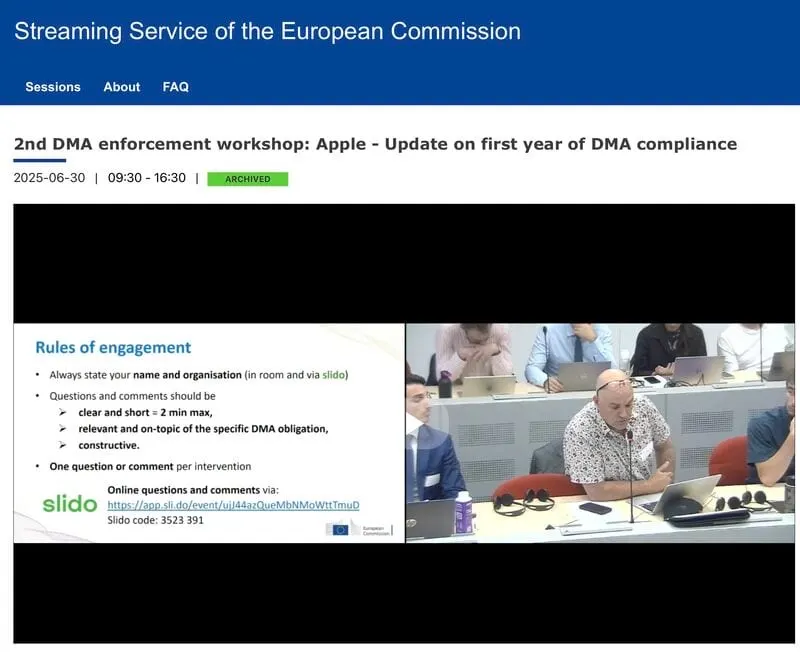
On Monday 30 June 2025, we attended a European Commission session on the Digital Markets Act as members of ACT | The App Association.
The European Commission has now published the video of the session.
Watch the European Commission DMA session
Why the DMA matters to small businesses
The Digital Markets Act is often discussed as a policy issue between regulators and large technology platforms.
But the practical effects are felt by smaller businesses too.
SMEs and independent developers rely on stable, trusted digital ecosystems to reach customers, distribute products and build sustainable businesses. As a company that builds mobile and augmented reality apps, we see this directly.
When regulation changes how those ecosystems operate, small companies need to understand the impact clearly.
Asking questions directly
We were able to put a number of questions to Apple during the session, particularly to Gary Davis and the legal team.
That kind of direct engagement matters. Small businesses need opportunities to put practical questions to the organisations and regulators shaping the environment they operate in.
It was a long day for everyone involved. Thank you to Mike Sax and Stephen Tulip of ACT | The App Association for representing the interests of the membership, and to the other ACT members who contributed.
What the compliance changes mean in practice
The DMA compliance process had been running in the EU for around a year.
From a user’s perspective, several changes are now visible or emerging:
- users are prompted to choose a browser when they upgrade their phones
- users can remove built-in apps, such as mail, camera and photos, and replace them with third-party alternatives
- data portability between iOS and Android is being expanded
- the app ecosystem is being opened so users may be able to download apps from a wider range of sources
Some of this may benefit European technology providers.
But our concern is that it may also make the experience worse and less safe for ordinary users.
More choice isn’t automatically useful if it creates more prompts, more consent fatigue and more confusion. Most phone users want a system that works reliably and safely. They don’t want to be forced into repeated decisions they don’t fully understand.
The risk is that this becomes click city: more boxes, more warnings, more settings and more opportunities for phishing and social engineering attacks.
Whose voices are being heard
The meeting included large companies and organisations, including Netflix, Spotify and Qualcomm, as well as independent software organisations and small independent software vendors.
From a small business perspective, it didn’t feel as if enough small software companies were properly represented.
That’s a problem. SMEs are a major engine of growth, but they don’t have the legal teams, policy departments or compliance budgets of larger companies. If regulation is shaped mainly by the largest and loudest voices, smaller businesses are left dealing with the consequences.
Regulation should help small companies grow
Apple and the other large technology platforms need accountability.
That doesn’t mean every regulatory intervention helps small businesses.
The most useful policy environment is one that helps small businesses become larger, through supportive ecosystems, access to finance, sensible compliance and fair routes to market.
Our concern is that the DMA may regulate large platforms in a way that creates side effects for everyone else. If investors see more uncertainty, more fragmentation and more compliance risk, it becomes harder for startups to grow into the larger companies policymakers say they want to create.
This matters for the UK too. If similar approaches arrive here, small businesses need to be in the room early, before the practical consequences are locked in.
The role of ACT
We attended as members of ACT | The App Association.
ACT gives small technology businesses a route into policy discussions that would otherwise be hard to access. That matters, because policy on digital markets, compliance, data and platforms affects how small companies grow, sell and protect their customers.
What we took away
The DMA conversation is complex. Competition, security, compliance and customer trust all have to be considered together.
For SMEs, the priority is practical: regulation should create fairer markets without creating new risks, customer confusion or compliance burdens that smaller businesses can’t absorb.
The goal should be a market where small companies can grow, users stay protected, and policy is based on evidence from the businesses that have to operate under it.